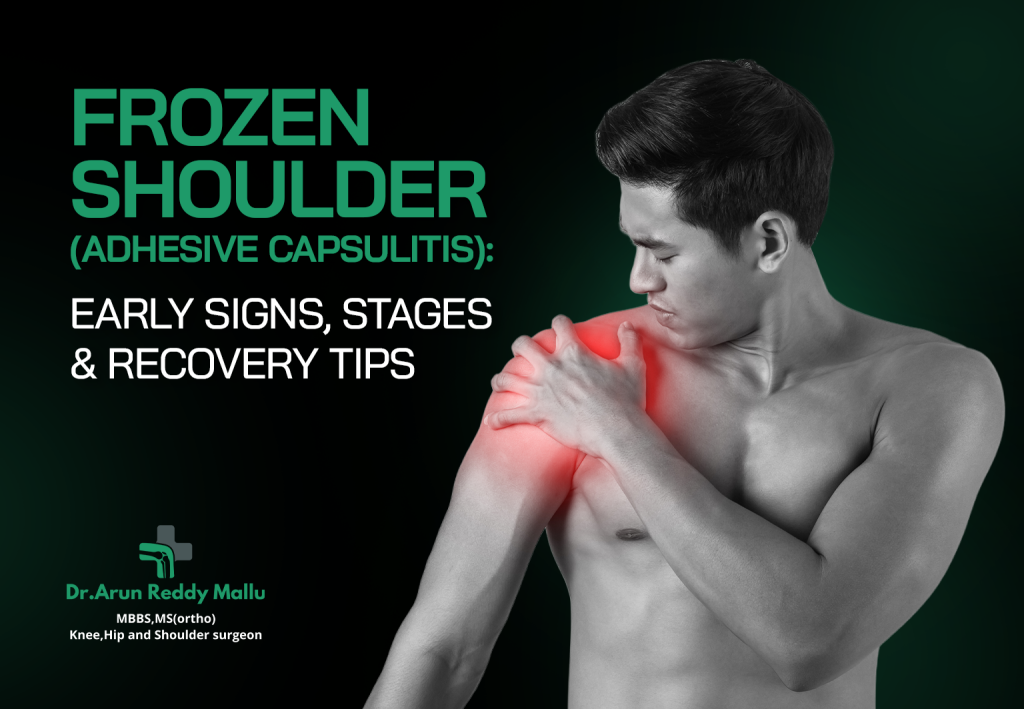
Frozen Shoulder (Adhesive Capsulitis): Early Signs, Stages & Recovery Tips
Frozen shoulder, medically known as adhesive capsulitis, is a painful and often debilitating condition of the shoulder joint. It can gradually restrict your ability to move your arm comfortably — affecting daily activities like dressing, reaching overhead, or even sleeping. While many people shrug off shoulder stiffness as “just getting older” or a consequence of minor injury, frozen shoulder is a specific clinical entity that benefits from early recognition and targeted management.
In this blog, we’ll walk you through:
- What frozen shoulder really is
- Early warning signs
- The four classic stages of the condition
- Practical recovery tips
- When to seek expert care, including insights from Arun Reddy Malluat Continental Hospitals
What Is Frozen Shoulder?
Frozen shoulder refers to inflammation and thickening of the capsule of the shoulder joint. The capsule is a connective tissue envelope that surrounds the shoulder, providing support and stability. In adhesive capsulitis, this capsule becomes inflamed, tight, and less elastic — effectively “freezing” the shoulder’s range of motion.
Although the exact cause isn’t always clear, it’s most commonly associated with:
- Long periods of shoulder immobility (after injury or surgery)
- Diabetes (highly correlated)
- Thyroid disorders
- Prior shoulder trauma
Unlike acute injuries or arthritis, frozen shoulder evolves gradually and can take months to resolve.
Early Signs & Symptoms To Watch For
Recognizing frozen shoulder early improves the chances of effective treatment and faster recovery. Here are the initial warning signs:
- Gradual Onset of Pain
The first symptom is usually a dull or aching pain deep within the shoulder. It may be worse at night or with specific movements. Often, people mistake this for muscle strain or fatigue.
- Progressive Stiffness
Within weeks, your shoulder may feel less flexible. You might notice difficulty with movements like:
- Reaching above your head
- Reaching behind your back
- Rotating your arm outward
This stiffness is typically painless at first but progresses.
- Pain With Activity
Simple tasks such as combing hair, putting on a jacket, or reaching into a cupboard can start to hurt. This is often the first time many patients realize something more than “simple muscle tightness” is happening.
- Sleep Disturbances
Persistent shoulder pain can interrupt sleep — especially when lying on the affected side. Difficulty achieving comfortable sleep positions is a common early complaint.
- Reduced Range of Motion
Your shoulder simply won’t move as freely as before. Clinically, both active movement (you move) and passive movement (someone else moves your arm) become restricted.
If you notice stiffness that doesn’t improve over several weeks — especially accompanied by worsening pain — it’s worth consulting a specialist.
Four Stages of Frozen Shoulder
Frozen shoulder doesn’t happen overnight. It evolves through four well-described stages. Each stage has distinctive features and implications for management.
- Stage 1 — The “Freezing” Stage
Duration: 6–9 months
Symptoms:
- Gradual increase in pain
- Stiffness starts, particularly with rotation
- Sleep disturbances
During this stage, shoulder movement becomes increasingly restricted as inflammation of the joint capsule progresses. Pain is the dominant symptom. Many people seek help at this point, but it’s often mistaken for tendonitis or bursitis.
- Stage 2 — The “Frozen” Stage
Duration: 4–12 months
Symptoms:
- Significant stiffness
- Pain may decrease slightly
- Range of motion is severely limited
In this stage, the shoulder becomes very tight. Although pain might lessen, stiffness has worsened — and daily activities become harder. Tasks such as fastening a bra, reaching overhead, or tucking in a shirt become difficult.
- Stage 3 — The “Thawing” Stage
Duration: 6–12 months
Symptoms:
- Gradual improvement in motion
- Less pain
- Function slowly returns
The body begins to “remodel” the stiffened joint capsule. Daily activities become easier, although full motion may not be restored until later.
- Stage 4 — Recovery & Remodeling
Duration: Variable (weeks to months after thawing)
Symptoms:
- Increasing flexibility
- Minimal pain
- Functional improvement
This stage represents recovery — improvements continue, although the timeline varies widely among individuals.
Managing Frozen Shoulder: Practical Tips
Effective management depends on early recognition and appropriate exercises, often combined with medical guidance. Here’s a comprehensive plan to support recovery.
- Gentle, Consistent Stretching
The cornerstone of recovery is controlled, gentle stretching to maintain and gradually increase range of motion:
- Pendulum stretch:Let your arm hang and gently swing in small circles.
- Towel stretch:Grasp a towel behind your back with both hands and gently pull.
- Cross-body reach:Use your good arm to lift the affected arm across your body.
Key: Never force movement to the point of sharp pain.
- Heat & Cold Therapy
- Heatbefore stretching can ease stiffness and relax muscles.
- Coldafter activity can reduce inflammation and discomfort.
Use moist heat or warm showers before exercises for best effect.
- Pain Management
Over-the-counter NSAIDs (e.g., ibuprofen) can help with inflammation and pain. Always consult a healthcare provider before starting medications, especially if you have gastric or kidney issues.
- Professional Physical Therapy
A trained physiotherapist can tailor exercises and manual therapy to your condition — crucial for optimal recovery. Techniques may include:
- Passive stretching
- Mobilization exercises
- Strengthening routines once motion improves
Consistency is key — daily therapy can significantly improve outcomes.
- Injections & Interventions
For cases where pain severely limits function, a doctor may recommend:
- Corticosteroid injectionsto reduce inflammation
- Nerve blocksfor pain relief
- Hydrodilatation(capsular distension with saline/contrast)
These should be guided by an experienced specialist.
- Avoid Prolonged Immobilization
Keeping your shoulder immobile (like in a sling) for long periods can worsen stiffness. Balance rest with gentle motion.
When To See a Specialist
If stiffness and pain persist for more than 6–8 weeks, or if everyday activities are compromised, getting expert evaluation is important.
At Continental Hospitals, orthopedic specialists — including Dr. Arun Reddy Mallu, who has extensive experience in shoulder conditions and minimally invasive therapies — can provide:
- Accurate diagnosis (clinical + imaging)
- Personalized treatment plans
- Guidance through physical therapy
- Advanced interventional options if needed
Dr. Arun Reddy Mallu emphasizes early recognition and tailored therapy to prevent long-term disability and optimize recovery.
Myths & Misconceptions
Let’s debunk a few common myths about frozen shoulder:
It only happens to older people.
While more common in people aged 40–60, it can affect adults of any age, especially after injury or surgery.
You should rest completely until it heals.
Complete rest increases stiffness. Controlled motion is therapeutic.
Steroid injections cure it.
Injections help with pain and inflammation but are usually part of a broader treatment plan that includes exercise.
A Realistic Timeline for Recovery
Patience is important. Frozen shoulder is self-limiting — it will eventually improve — but the total natural course can take 1–3 years without treatment.
With early therapy and guided care:
- Pain often starts to reduce within weeks
- Motion improves progressively
- Most patients regain functional use within 6–12 months
Remember, individual recovery varies.
Conclusion
Frozen shoulder (adhesive capsulitis) is a condition marked by progressive shoulder stiffness and pain that can significantly affect quality of life. Understanding the early signs — gradual pain, stiffness, sleep disturbances, and limited range of motion — helps you seek care sooner. Recognizing the four stages — freezing, frozen, thawing, and recovery — lets you set realistic expectations and tailor your management.
The heart of treatment lies in:
- Gentle range-of-motion exercises
- Consistent physical therapy
- Targeted pain management
- Guidance from experienced specialists
If your symptoms persist or worsen, consult an orthopedic expert. Specialists like Dr. Arun Reddy Mallu at Continental Hospitals can provide comprehensive evaluation and individualized care plans — from conservative therapy to advanced interventions — to help you regain shoulder mobility and return to a pain-free life.
Frozen shoulder doesn’t have to “just run its course.” With the right approach, you can navigate recovery with confidence and comfort.
Frozen shoulder treatment by Dr. Arun Reddy Mallu at Continental Hospitals — call +91 99591 35963.