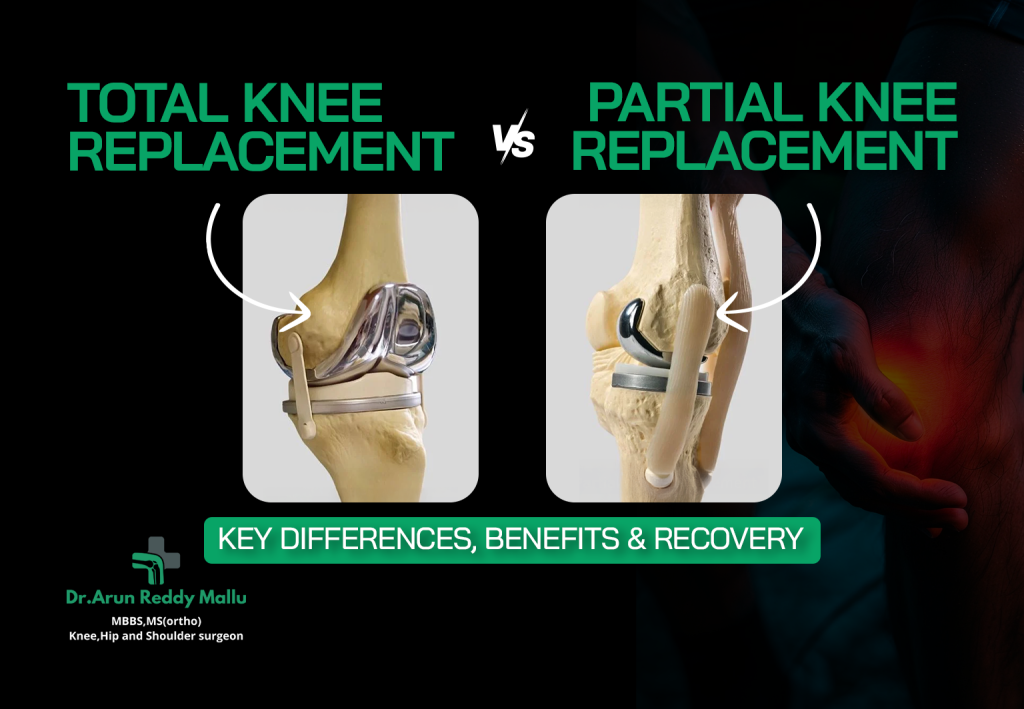
Total Knee Replacement vs Partial Knee Replacement – Key Differences, Benefits & Recovery
Knee pain caused by arthritis, injury, or age-related wear and tear can make daily activities difficult. When conservative treatments like physiotherapy, medications, or injections no longer provide relief, knee replacement surgery becomes a highly effective option. But here’s where many patients pause — should you go for a Total Knee Replacement (TKR) or a Partial Knee Replacement (PKR)?
Understanding the differences between these two procedures, their benefits, and recovery timelines can help you make an informed decision. In this article, we’ll break it down, with expert insights from Dr. Arun Reddy Mallu, an experienced orthopaedic and joint replacement surgeon at Continental Hospitals.
What is Total Knee Replacement (TKR)?
Total Knee Replacement involves replacing all three compartments of the knee — the medial (inner), lateral (outer), and patellofemoral (kneecap) areas. This is the preferred approach when arthritis or damage is widespread across the entire joint.
Procedure Overview:
- The damaged bone and cartilage are removed from the femur (thigh bone), tibia (shin bone), and patella.
- Artificial components made of metal and high-grade plastic are implanted.
- The alignment of the joint is corrected for smoother, pain-free movement.
When It’s Recommended:
- Advanced osteoarthritis affecting all knee compartments.
- Severe deformity of the knee joint.
- Major joint instability and stiffness.
- Previous unsuccessful partial replacement or other knee surgeries.
What is Partial Knee Replacement (PKR)?
Partial Knee Replacement, also called unicompartmental knee replacement, involves replacing only the damaged section of the knee. The healthy cartilage and bone are preserved, which allows for a more natural knee function post-surgery.
Procedure Overview:
- Only the affected compartment (most often the medial side) is resurfaced.
- A smaller incision is used compared to TKR.
- Preserves more of the patient’s natural knee structure.
When It’s Recommended:
- Damage or arthritis is limited to a single knee compartment.
- Good overall knee stability and alignment.
- Adequate range of motion is still present.
- Patients who are younger or more active may benefit from preserving natural joint tissue.
Benefits of Total Knee Replacement
- Comprehensive Solution– Ideal for patients with extensive joint damage.
- Long-Lasting Results– Modern implants can last decades with proper care.
- Corrects Major Deformities– Improves alignment and stability.
- High Success Rate– TKR is one of the most successful orthopaedic surgeries worldwide.
Benefits of Partial Knee Replacement
- Less Invasive– Smaller incision, less trauma to surrounding tissues.
- Faster Recovery– Many patients resume daily activities sooner.
- Better Range of Motion– Preserves healthy bone, ligaments, and cartilage.
- More Natural Feel– Knee often feels closer to the patient’s original joint.
Recovery Process: What to Expect
Whether you undergo TKR or PKR, recovery is a crucial part of the journey. According to Dr. Arun Reddy Mallu, “Your commitment to post-surgery rehabilitation plays as big a role in the outcome as the surgery itself.”
Hospital Stay
- TKR: Typically 3–5 days.
- PKR: 1–3 days; some patients are discharged the next day.
Initial Recovery (First 2 Weeks)
- Pain management with prescribed medication.
- Use of walking aids like crutches or a walker.
- Gentle physiotherapy starts within 24 hours to maintain mobility.
Rehabilitation (Weeks 3–8)
- Focus on strengthening surrounding muscles.
- Gradual increase in walking distance and range-of-motion exercises.
- For PKR, patients may be walking unaided in 3–4 weeks; for TKR, it can take 6–8 weeks.
Long-Term Recovery (3–12 Months)
- Continued improvement in strength and flexibility.
- Most TKR patients resume normal activities by 3 months, but full recovery can take up to a year.
- PKR patients often reach full recovery earlier, though durability may vary.
Potential Risks and Considerations
Like any surgery, knee replacement carries some risks:
- Infection
- Blood clots
- Implant loosening or wear
- Nerve injury
- Need for revision surgery
However, with advancements in surgical techniques, patient-specific planning, and robotic-assisted procedures, these risks are lower than ever. Dr. Arun Reddy Mallu emphasises that selecting the right type of replacement is key to minimising long-term complications.
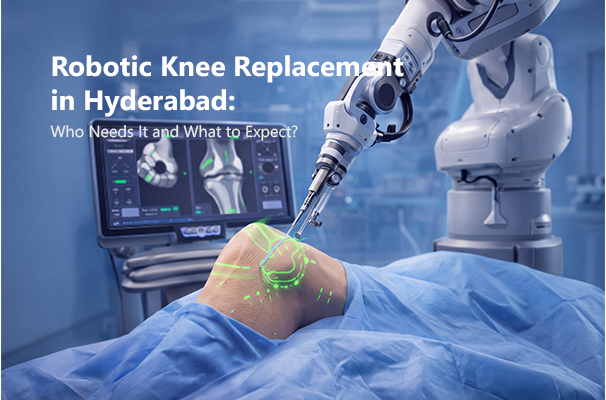
Robotic-Assisted Knee Replacement: A Modern Advantage
Robotic technology is increasingly being used in both TKR and PKR. It allows for:
- Greater surgical precision.
- Customised implant positioning.
- Better alignment, which may improve implant longevity.
Dr. Arun Reddy Mallu is known for incorporating advanced techniques, including robotic-assisted surgery, to improve patient outcomes and reduce recovery times.
How to Choose Between TKR and PKR
The choice depends on:
- Extent of Joint Damage– If only one compartment is affected, PKR might be sufficient.
- Age & Activity Level– Younger, active patients may benefit from PKR, but risk of future surgeries exists.
- Overall Health– Patients with poor bone quality or significant deformities may require TKR.
- Surgeon’s Assessment– An experienced orthopaedic surgeon like Dr. Arun Reddy Mallu can evaluate X-rays, MRI scans, and physical examination results to recommend the best approach.
Life After Knee Replacement
Post-surgery, most patients experience:
- Significant pain reduction.
- Improved walking ability and mobility.
- Enhanced quality of life — from climbing stairs to returning to hobbies.
However, knee replacements are not a free pass to high-impact sports. Activities like running or jumping should be avoided to prolong implant life. Low-impact exercises such as swimming, cycling, and yoga are encouraged.
Conclusion
Both Total Knee Replacement and Partial Knee Replacement are highly effective solutions for relieving chronic knee pain and restoring mobility. The main difference lies in the extent of damage being treated — TKR addresses the entire joint, while PKR focuses on one compartment.
If you’re struggling with persistent knee pain, consult an experienced orthopaedic specialist Dr. Arun Reddy Mallu. With proper evaluation, the right surgical choice, and a dedicated rehabilitation plan, you can look forward to walking, climbing stairs, and enjoying an active life again — free from the limitations of knee pain.
Consult Dr. Arun Reddy Mallu at Continental Hospitals to determine whether Total or Partial Knee Replacement is the best fit for your needs.