Hip Arthritis – Hip Arthritis is a common joint condition that affects millions of people worldwide and is one of the leading causes of hip pain, stiffness, and reduced mobility. The hip joint is a ball-and-socket joint that allows smooth movement during walking, running, sitting, and other daily activities. When the cartilage protecting the hip joint begins to wear down or becomes inflamed, it can lead to arthritis, causing discomfort and limiting normal movement.
As people age, the risk of developing Hip Arthritis increases. However, the condition can also affect younger individuals due to injuries, autoimmune disorders, congenital abnormalities, or underlying joint diseases. Early diagnosis and appropriate treatment are essential for preserving joint function and maintaining quality of life.
Dr. Arun Reddy Mallu, one of the leading orthopedic surgeons in Hyderabad, specializes in hip disorders, robotic joint replacement, sports injuries, arthroscopy, and advanced orthopedic care. His expertise in hip preservation and hip replacement surgery helps patients regain mobility and live pain-free lives.
Understanding Hip Arthritis
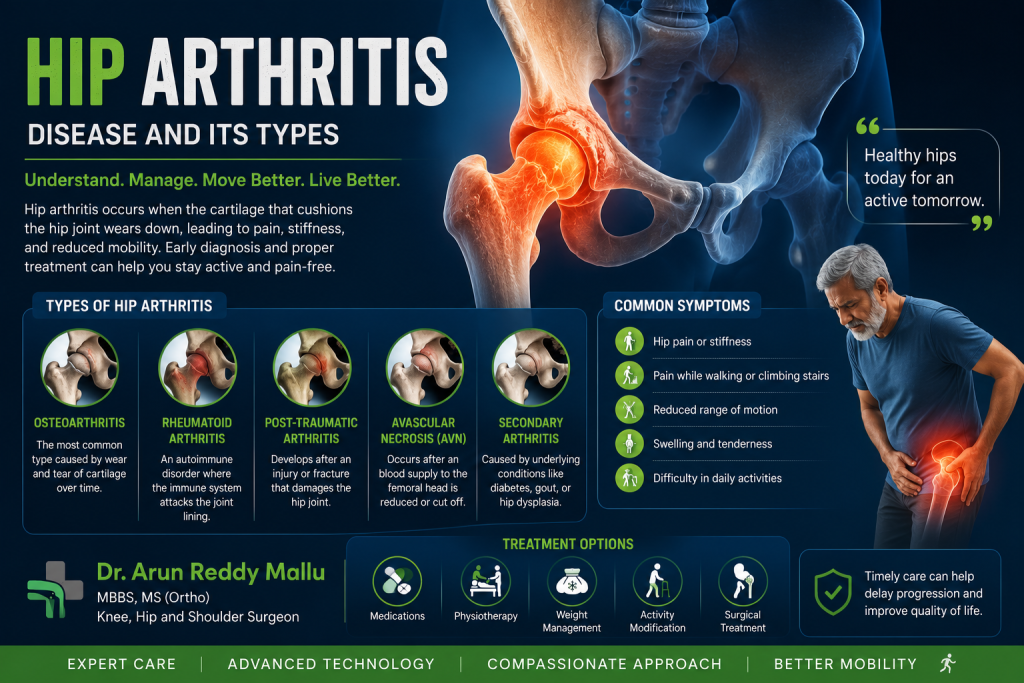
Hip Arthritis occurs when the cartilage lining the hip joint becomes damaged or worn away. Cartilage acts as a cushion between bones and allows smooth, friction-free movement. When cartilage deteriorates, bones begin rubbing against each other, resulting in pain, inflammation, stiffness, and decreased mobility.
The severity of Hip Arthritis varies from mild discomfort to severe joint destruction requiring surgical intervention. While arthritis is often associated with aging, several other factors can contribute to its development.
Anatomy of the Hip Joint
To understand Hip Arthritis, it is important to know how the hip joint functions.
The hip consists of:
- Femoral Head (ball)
- Acetabulum (socket)
- Articular Cartilage
- Joint Capsule
- Ligaments
- Surrounding Muscles
These structures work together to provide stability, flexibility, and smooth movement. Damage to any of these components can contribute to joint degeneration and arthritis.
Common Symptoms of Hip Arthritis
The symptoms of Hip Arthritis often develop gradually and worsen over time.
Common signs include:
- Hip pain during movement
- Groin pain
- Stiffness after sitting
- Reduced range of motion
- Difficulty walking
- Limping
- Pain while climbing stairs
- Difficulty getting out of a chair
- Clicking or grinding sensations
- Pain radiating to the thigh or knee
In advanced stages, pain may occur even during rest or sleep.
Causes of Hip Arthritis
Several factors contribute to Hip Arthritis.
Age-Related Wear and Tear
Natural degeneration of cartilage over time remains the most common cause.
Previous Hip Injuries
Fractures, dislocations, and sports injuries can accelerate joint deterioration.
Genetics
A family history of arthritis increases the risk.
Obesity
Excess body weight places additional stress on the hip joint.
Autoimmune Disorders
Conditions such as rheumatoid arthritis can cause joint inflammation and damage.
Avascular Necrosis
Loss of blood supply to the femoral head can lead to bone collapse and arthritis. Dr. Arun Reddy Mallu has extensive experience managing AVN Hip through specialized treatment protocols.
Types of Hip Arthritis
Understanding the various forms of Hip Arthritis helps determine the most effective treatment strategy.
Osteoarthritis: The Most Common Type of Hip Arthritis
Osteoarthritis is the most frequently diagnosed type of Hip Arthritis.
It develops when cartilage gradually wears away over time.
Symptoms include:
- Progressive pain
- Joint stiffness
- Reduced flexibility
- Difficulty walking
Osteoarthritis typically affects middle-aged and elderly individuals.
Rheumatoid Hip Arthritis
Rheumatoid Arthritis is an autoimmune condition where the immune system attacks healthy joint tissues.
Characteristics include:
- Chronic inflammation
- Joint swelling
- Morning stiffness
- Progressive joint destruction
Unlike osteoarthritis, rheumatoid arthritis can affect multiple joints simultaneously.
Post-Traumatic Hip Arthritis
This type develops following a significant injury to the hip.
Common causes include:
- Hip fractures
- Sports injuries
- Hip dislocations
- Cartilage damage
Even after successful treatment of the original injury, arthritis may develop years later.
Avascular Necrosis-Related Hip Arthritis
Avascular Necrosis (AVN) occurs when blood supply to the femoral head becomes compromised.
Without adequate blood flow:
- Bone tissue dies
- Femoral head collapses
- Arthritis develops
Dr. Arun Reddy Mallu specializes in AVN Hip management and advanced hip preservation strategies.
Inflammatory Hip Arthritis
Inflammatory conditions can damage joint structures and lead to arthritis.
Examples include:
- Psoriatic arthritis
- Ankylosing spondylitis
- Lupus-related arthritis
These conditions often require specialized medical management.
Risk Factors for Hip Arthritis
Several factors increase the likelihood of developing Hip Arthritis.
Increasing Age
Cartilage naturally wears down with age.
Obesity
Extra weight increases pressure on the hip joint.
Family History
Genetic predisposition plays a role.
Previous Injuries
Sports injuries and fractures can accelerate degeneration.
Structural Hip Abnormalities
Certain congenital conditions may increase arthritis risk.
Diagnosing Hip Arthritis
Accurate diagnosis is essential for successful treatment.
Orthopedic evaluation typically includes:
Medical History
Understanding symptoms and risk factors.
Physical Examination
Assessing movement, flexibility, and pain.
X-rays
Evaluating joint space narrowing and bone changes.
MRI Scans
Providing detailed assessment of cartilage and surrounding structures.
Advanced imaging helps determine the severity of Hip Arthritis and guide treatment planning.
Non-Surgical Treatment for Hip Arthritis
Many patients benefit from conservative treatment approaches.
Activity Modification
Avoiding activities that aggravate symptoms.
Weight Management
Reducing body weight decreases joint stress.
Physical Therapy
Improves:
- Strength
- Flexibility
- Stability
- Mobility
Medications
Used to reduce pain and inflammation.
Lifestyle Modifications
Healthy habits can significantly improve symptoms and slow disease progression.
Role of Sports Medicine in Hip Arthritis
Patients with sports-related hip injuries often require specialized care.
Dr. Arun Reddy Mallu’s expertise in Sports Medicine and Arthroscopy allows early diagnosis and treatment of hip conditions before severe arthritis develops. His focus on joint preservation helps maintain long-term function and mobility.
When Hip Replacement Surgery Becomes Necessary
For advanced Hip Arthritis, surgery may become the most effective treatment option.
Surgery is typically considered when:
- Pain becomes severe
- Daily activities are limited
- Sleep is disturbed
- Non-surgical treatments fail
Modern hip replacement surgery can dramatically improve quality of life.
Robotic Hip Replacement for Advanced Hip Arthritis
Robotic-assisted surgery represents one of the most advanced treatments available for Hip Arthritis.
Benefits include:
- Greater precision
- Better implant alignment
- Personalized surgical planning
- Improved joint function
- Potentially faster recovery
Dr. Arun Reddy Mallu has specialized fellowship training in Robotic Joint Replacement Surgery and performs advanced hip replacement procedures for complex cases.
Direct Anterior Hip Replacement
One of Dr. Arun Reddy Mallu’s advanced areas of expertise is the Direct Anterior Approach for Total Hip Replacement.
This minimally invasive approach may offer:
- Less muscle disruption
- Faster rehabilitation
- Reduced pain
- Earlier mobility
The technique is particularly beneficial for suitable candidates requiring hip replacement surgery.
Recovery After Hip Replacement Surgery
Successful recovery involves:
- Physical therapy
- Walking programs
- Strengthening exercises
- Regular follow-up care
Most patients experience significant improvements in pain relief and mobility after surgery.
Preventing Hip Arthritis Progression
Although not all cases can be prevented, certain measures may help reduce progression.
Maintain a Healthy Weight
Reduces pressure on hip joints.
Stay Physically Active
Supports joint health and mobility.
Treat Injuries Promptly
Early management prevents long-term complications.
Strengthen Supporting Muscles
Improves joint stability.
Seek Early Orthopedic Care
Timely intervention leads to better outcomes.
About Dr. Arun Reddy Mallu
Dr. Arun Reddy Mallu is a highly respected Consultant Orthopedic Surgeon specializing in Orthopedics, Trauma, Arthroscopy, Joint Replacements, and Sports Medicine at Continental Hospitals, Hyderabad. With over a decade of experience, he is recognized for his expertise in knee and hip joint replacement surgeries, sports injury treatment, and robotic-assisted orthopedic procedures.
His areas of specialization include:
- Robotic Knee Replacement
- Robotic Hip Replacement
- Total Hip Replacement
- Direct Anterior Hip Replacement
- ACL Reconstruction
- Sports Injury Treatment
- Shoulder Arthroscopy
- Revision Joint Replacement Surgery
- Complex Trauma Care
Dr. Arun has completed fellowships in Robotic Joint Replacements and Arthroscopy & Sports Medicine and has undergone advanced international training under leading orthopedic experts. He continuously adopts modern technologies and evidence-based techniques to improve patient outcomes.
His patient-centered approach focuses on personalized treatment plans that help patients achieve pain-free mobility and an improved quality of life.
Dr. Arun Reddy Mallu Contact Information
Call:- 9959135963
Whatsapp:- 9959135963
Facebook:- DrArunReddyMallu
Instagram:- drarunreddymallu
Youtube:- https://www.youtube.com/channel/UCt_XTYwyqpzloXtkTLblwxw
LinkedIn:- drarunmallu
Conclusion
Hip Arthritis is a progressive joint condition that can significantly affect mobility, independence, and overall quality of life. Understanding the disease and its various types allows patients to seek timely treatment and prevent long-term complications. Whether the condition is caused by osteoarthritis, rheumatoid arthritis, AVN, or previous injuries, early diagnosis and proper management can help preserve joint function.
For advanced cases, modern treatment options such as Robotic Hip Replacement and Direct Anterior Hip Replacement offer excellent outcomes and improved recovery. Under the expert care of Dr. Arun Reddy Mallu, patients receive comprehensive orthopedic care designed to reduce pain, restore movement, and help them return to an active lifestyle.
Related Tags:-
- Best Orthopedic Surgeon in Hyderabad
- robotic knee replacement
- sports injury specialist
- ACL Reconstruction surgeon
- shoulder arthroscopy
- Joint Replacement Surgeon
- Signs of Joint Damage
- Muscle Injury Causes
- Sprained Your Ankle
- Hip Replacement Recovery
- Managing Knee Osteoarthritis
- Tips for Recovery after Knee Surgery
- Hip Arthritis