A real patient story of how recurrent kneecap dislocation was permanently fixed at Continental Hospitals, Hyderabad by Dr. Arun Reddy Mallu, a distinguished orthopaedic & robotic knee replacement surgeon at Continental Hospitals.
The Problem: A Kneecap That Wouldn’t Stay in Place
Imagine this.
You’re 29 years old. You’re walking around your house. You bend your knee slightly and suddenly; your kneecap slides out of place. The pain is sharp. You can’t walk properly. And you’re left wondering – why did this happen again?
That was Priya’s life. (Name changed.)
For almost 3 years, her right kneecap kept dislocating, slipping out of its place again and again. Not because she fell. Not because of any accident or sports injury. It just happened on its own, without any warning.
And every time it happened, the fear got worse.
- She started changing the way she lived:
- She stopped playing sports entirely.
- She began walking slowly and carefully always scared the knee would give way.
- Simple daily activities climbing stairs, going to the market became stressful.
- Her confidence dropped. Her independence was slipping away.
She had already visited multiple hospitals. She had tried physiotherapy and medicines. But nothing worked for long. The kneecap would dislocate again, and the whole painful cycle would start over.
That’s when someone guided her to Continental Hospitals, Hyderabad and to Dr. Arun Reddy Mallu.
“Why Does Kneecap Keep Dislocating?” – The Real Answer
This is the most common question patients with recurrent kneecap dislocation ask. And most of them have never received a proper answer.
When Priya came to Dr. Arun Reddy Mallu, he didn’t just look at her knee. He looked deeper – at the structure of her knee, the shape of her bones, and the condition of her ligaments.
After a thorough examination and detailed imaging, three separate problems were found – each one making her kneecap instability worse:
3 Reasons Her Kneecap Kept Dislocating
Reason 1: The Groove in Her Knee Was Too Shallow
Think of the kneecap like a ball sitting inside a bowl. Normally, the bowl is deep enough to keep the ball in place. In Priya’s case, the bowl was almost flat. So the kneecap had no real support — it could slide out very easily.
Reason 2: Her Kneecap Was Sitting Too High
Her kneecap was positioned slightly higher than normal. This meant it took too long to settle into the groove when she bent her knee – leaving it unstable and vulnerable during everyday movements.
Reason 3: A Torn Inner Ligament
There is a ligament on the inner side of the knee that acts like a seatbelt for the kneecap -stopping it from sliding outward. Priya’s was torn and not working. Without it, there was nothing to stop the kneecap from popping out.
This is why previous treatments had failed. They were addressing only one problem at a time – or not addressing the bone structure at all. A partial fix was never going to work here.
All three problems needed to be corrected together in a single surgery.
The Surgery: Fixing the Bone and Rebuilding the Ligament
Dr. Arun Reddy Mallu designed a clear plan: fix the root cause, not just the symptoms.
The surgery had two parts – both performed together in a single operation. Here’s what happened, explained simply:
Part 1 – Moving the Kneecap Anchor to the Right Position
The kneecap is connected to the shin bone by a strong tendon. The point where this tendon attaches to the shin bone was in the wrong position – it was pulling the kneecap sideways and upward.
Dr. Arun Reddy Mallu moved this attachment point slightly downward and slightly inward to bring the kneecap to the correct position, so it could sit properly inside the groove.
Small orthopaedic screws were used to hold the bone in its new position. This is called kneecap realignment surgery and it directly corrects the structural problem that was causing the kneecap to dislocate.
Part 2 – Rebuilding the Torn Inner Ligament
The torn inner ligament – the kneecap’s natural seatbelt was completely rebuilt.
A small tendon from the back of Priya’s own thigh was used as a replacement. This is her own natural tissue it bonds well with the knee and becomes a permanent part of the joint.
This rebuilt ligament now acts as a strong check on the kneecap. Every time the knee bends and straightens, the ligament keeps the kneecap from sliding outward. This is called MPFL reconstruction – one of the most effective treatments for recurrent kneecap dislocation.
Together, these two procedures gave Priya’s knee what it had been missing for 3 years: a proper bone structure to hold the kneecap in place, and a strong ligament to keep it there.
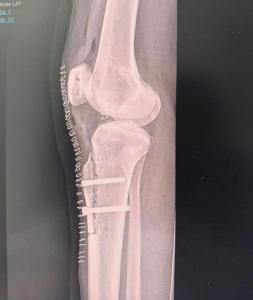
AP View (Front View)
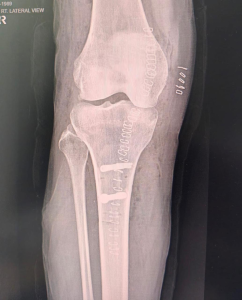
Lateral View (Side View)
Postoperative X-rays showing screw fixation and successful bone realignment after kneecap stabilisation surgery
The Week by Week Recovery:
Priya started physiotherapy within days of the surgery. Her recovery was structured, supervised, and steady.
| Recovery Week | What Happened |
| Week 1 – 2 | Pain was reducing. Started gentle movement and light exercises. |
| Week 3 – 4 | Walking with support. Knee felt noticeably more stable. |
| Week 5 – 6 | Walking without any support. No dislocation episode at all. |
| Week 7 – 8 | Walking normally. Zero pain. Zero fear. Full confidence restored. |
At the 8-week follow-up appointment, the results were clear. The kneecap had not dislocated even once since surgery. Her range of motion was completely restored. She was walking normally – no guarding, no fear, no support needed.
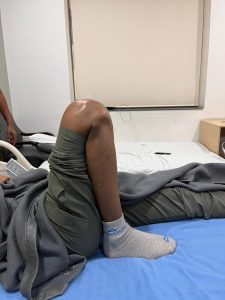
Postoperative photograph showing early knee bending achieved within days of kneecap stabilisation surgery
In 8 weeks, she went from being afraid to walk across a room to living her normal life again.
8-Week Post-Op Recovery — Patient Walking Without Support After MPFL Reconstruction.
Before Surgery vs. After Surgery: The Full Transformation
| Before Surgery | After Surgery (8 Weeks) |
| Kneecap dislocating repeatedly | Zero dislocations after surgery |
| Walking in fear, guarded every step | Walking freely and confidently |
| Stopped sports and outdoor activities | Returned to normal daily life |
| Multiple hospitals – no lasting relief | Permanent fix in a single surgery |
| Low confidence, restricted independence | Full confidence and independence restored |
Are You Facing the Same Problem? Here’s What You Should Know.
If your kneecap keeps slipping out even without any injury or fall – you are not alone. This is more common than most people think, especially in young women between the ages of 15 and 35.
Here are the most important things to understand:
- A kneecap that dislocates without injury usually means there is a structural problem – not just weak muscles.
- Physiotherapy and knee braces can help manage mild cases. But if the kneecap keeps dislocating, surgery is the only lasting solution.
- Not all kneecap dislocation cases are the same. The root cause must be properly diagnosed before surgery is planned.
- The right surgery done by an experienced knee surgeon has very high success rates. Re-dislocation after a proper surgery is less than 10%.
- Recovery can be faster than you expect. With the right physiotherapy, most patients are walking normally within 6 to 8 weeks.
Do You Have Similar Symptoms?
You might need kneecap dislocation treatment if you experience:
- Kneecap slipping out repeatedly
- Knee giving way while walking
- Pain without major injury
- Fear of movement
- No relief with physiotherapy
When Should You See a Knee Specialist?
Consult an orthopedic surgeon in Hyderabad if:
- Dislocation has happened more than once
- Your knee feels unstable daily
- You’ve already tried non-surgical treatments
- Your lifestyle is getting affected
Important Things to Know
- Recurrent dislocation usually means a structural issue
- Braces and physiotherapy help only in mild cases
- Surgery offers a long-term solution in advanced cases
- Success rates are very high with proper diagnosis
- Most patients recover within 6–8 weeks
Does your kneecap keep slipping out of place?
Don’t wait for it to get worse. Don’t settle for a temporary fix.
Get a proper diagnosis from Dr. Arun Reddy Mallu – one of the best orthopedic doctors in Hyderabad for knee, shoulder, and hip conditions.
Dr. Arun Reddy Mallu is recognized as the Top Robotic Knee Replacement Surgeon in Hyderabad with 1000+ successful surgeries. combining advanced robotic precision with deep orthopedic expertise to deliver outstanding patient outcomes.
If you are looking for the Best Robotic Knee Replacement Surgeon in Hyderabad for a complex knee condition, Dr. Arun Reddy Mallu at Continental Hospitals offers world-class surgical care with proven results.
Patients seeking the Best Robotic Knee Replacement Surgeon in Hyderabad trust Dr. Arun Reddy Mallu for his expertise in both kneecap stabilization and complex knee reconstruction procedures.
Knee Dislocation Surgery performed by Dr. Arun Reddy Mallu addresses the root structural causes of kneecap instability, offering patients a permanent and lasting solution.
If you have been told you need Knee Dislocation Surgery, consult Dr. Arun Reddy Mallu at Continental Hospitals, Hyderabad for an accurate diagnosis and a personalized surgical plan.
Knee Dislocation Surgery at Continental Hospitals is performed using the latest techniques, ensuring minimal recovery time and maximum stability for every patient.
Choosing the Best Robotic Knee Replacement Surgeon in Hyderabad means choosing a specialist who understands your unique anatomy and delivers precision-driven care from consultation to recovery.
For advanced Knee Dislocation Surgery or robotic knee procedures in Hyderabad, reach out to Dr. Arun Reddy Mallu’s team at Continental Hospitals and take the first step toward a pain-free life.
As the Best Robotic Knee Replacement Surgeon in Hyderabad, Dr. Arun Reddy Mallu has helped hundreds of patients restore full knee function and return to active, confident living.
Book your consultation with Dr. Arun Reddy Mallu, a leading Robotic Knee Replacement Surgeon in Hyderabad, at Continental Hospitals. Call +91 99591 35963 today to schedule your appointment.