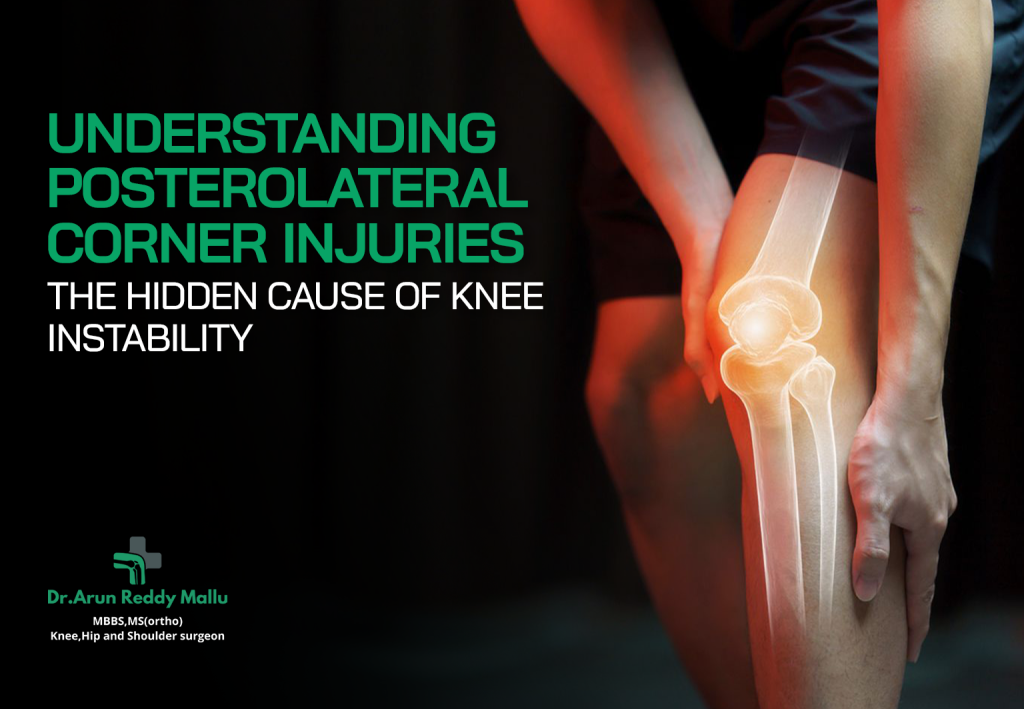
Understanding Posterolateral Corner Injuries – The Hidden Cause of Knee Instability
When we think of knee injuries, the ACL (anterior cruciate ligament) and meniscus often take the spotlight. However, there’s a lesser-known yet crucial structure that plays a significant role in knee stability — the posterolateral corner (PLC). Injuries to this region are often overlooked or misdiagnosed, leading to chronic knee instability, pain, and difficulty returning to normal activities.
In this article, we’ll explore what the posterolateral corner is, why injuries to it are so impactful, how they are diagnosed, and the modern treatment options available to restore knee stability.
What Is the Posterolateral Corner (PLC)?
The posterolateral corner of the knee is a complex network of ligaments, tendons, and muscles that stabilize the knee joint, especially against external rotation and backward movement of the tibia (shin bone).
The key structures in the PLC include:
- Lateral collateral ligament (LCL):Provides stability on the outer side of the knee.
- Popliteus tendon:Helps control rotation of the knee and prevents excessive outward rolling.
- Popliteofibular ligament:Supports the popliteus tendon in preventing excessive motion.
- Arcuate ligament complex and posterolateral capsule:Additional supporting structures that add rotational and lateral stability.
Together, these elements work in harmony with other ligaments like the ACL and PCL (posterior cruciate ligament) to maintain proper knee alignment and movement.
How Do Posterolateral Corner Injuries Occur?
PLC injuries usually happen due to high-energy trauma or sudden twisting forces on the knee. Common causes include:
- Sports injuries:
Athletes in sports like football, soccer, basketball, and skiing are at higher risk. Sudden pivoting or a direct blow to the inside of the knee can stretch or tear the PLC structures. - Motor vehicle accidents:
A direct impact to the knee during a crash can lead to severe PLC injuries, often in combination withACL or PCL tears. - Falls or hyperextension injuries:
Landing awkwardly after a jump or an unexpected twist while running can overstretch the ligaments of the posterolateral corner. - Combined ligament injuries:
PLC injuries often don’t occur in isolation. They are commonly seen along with ACLor PCL tears, complicating both diagnosis and treatment.
Symptoms of Posterolateral Corner Injuries
Many people with PLC injuries may not realize the true source of their knee instability because symptoms often mimic those of other ligament injuries. Common signs include:
- Knee instability:A feeling that the knee “gives way” during walking or pivoting.
- Pain on the outer side of the knee:Especially noticeable when twisting or turning.
- Swelling and tenderness:Around the outer and back portion of the knee.
- Difficulty climbing stairs or changing direction:Due to loss of rotational control.
- Locking or clicking sensation:When the knee moves through its range of motion.
If left untreated, these symptoms can worsen over time, leading to chronic instability and even early osteoarthritis.
Why Are PLC Injuries Often Missed?
PLC injuries can be challenging to diagnose because:
- The symptoms overlap with ACL or meniscus injuries.
- Standard imaging tests may not always clearly show damage to the smaller structures in the PLC.
- The focus is often on more commonly injured ligaments, leaving PLC tears unaddressed.
When a PLC injury is missed, patients who undergo ACL reconstruction alone may continue to feel instability or have repeated graft failures. That’s why accurate diagnosis and comprehensive treatment are essential.
Diagnosis of Posterolateral Corner Injuries
Diagnosing PLC injuries requires a detailed clinical examination and advanced imaging.
- Clinical Examination
An orthopedic specialist performs several tests to evaluate knee stability, including:
- Dial Test:Checks for excessive external rotation at the knee.
- Varus Stress Test:Assesses lateral stability of the knee joint.
- External Rotation Recurvatum Test:Evaluates both rotational and hyperextension instability.
These tests help identify the specific ligaments and tendons affected.
- Imaging Tests
- MRI (Magnetic Resonance Imaging):The most accurate imaging tool to visualize soft tissue injuries. MRI can reveal tears in the LCL, popliteus tendon, or other PLC structures.
- X-rays:Used to detect any bone injuries or alignment issues.
- Stress Radiographs:May be used to assess the degree of joint laxity under stress.
An experienced orthopedic surgeon will correlate clinical findings with imaging results to confirm the diagnosis and plan treatment.
Grades of PLC Injury
PLC injuries are classified into three grades based on severity:
- Grade I (Mild):Stretching of the ligaments with minimal instability.
- Grade II (Moderate):Partial tear with some joint laxity.
- Grade III (Severe):Complete tear of multiple structures leading to significant instability.
Accurate grading is essential, as it determines whether conservative management or surgical reconstruction is needed.
Treatment Options for Posterolateral Corner Injuries
The treatment plan depends on the severity of the injury and whether other ligaments are also affected.
- Non-Surgical Treatment (For Mild Injuries)
For Grade I or some Grade II injuries:
- Rest and immobilization:To allow the damaged tissues to heal.
- Physical therapy:Strengthening exercises for quadriceps, hamstrings, and hip muscles to improve knee stability.
- Bracing:A hinged knee brace may be recommended to restrict excessive movement.
- Gradual return to activity:Under the supervision of a physiotherapist.
Non-surgical management can yield good results in minor injuries if rehabilitation is done correctly.
- Surgical Treatment (For Moderate to Severe Injuries)
For Grade II (severe) and Grade III injuries, especially when combined with ACL or PCL tears, surgical reconstruction is often necessary.
PLC Reconstruction:
- The surgeon reconstructs the damaged ligaments using grafts (from the patient’s own tissue or a donor).
- The goal is to restore the natural anatomy and function of the knee’s posterolateral corner.
- Surgery may be performed along with ACL or PCL reconstruction for complete joint stability.
Post-Surgical Rehabilitation:
Rehabilitation is a critical phase of recovery and typically includes:
- Controlled weight-bearing with crutches for the first few weeks.
- Range-of-motion exercises to prevent stiffness.
- Gradual strengthening and balance training.
- Return to sports or heavy physical activity usually after 6–9 months, depending on recovery.
Early and precise surgical intervention significantly improves outcomes and helps prevent long-term instability.
Potential Complications of Untreated PLC Injuries
Ignoring or misdiagnosing a PLC injury can lead to:
- Persistent instability:Difficulty walking, running, or pivoting.
- Recurrent ligament tears:Especially if ACL reconstruction is done without addressing PLC damage.
- Joint degeneration:Leading to early onset osteoarthritis.
- Chronic pain and reduced performance:Particularly in athletes or active individuals.
Hence, timely diagnosis and a multidisciplinary treatment approach are crucial for long-term knee health.
Recovery and Return to Activity
Recovery from a PLC injury — whether treated surgically or non-surgically — depends on several factors: the severity of the injury, patient fitness level, adherence to physiotherapy, and overall joint health.
With proper medical care and a personalized rehabilitation program, most patients can return to their normal activities, sports, and work with restored stability and confidence.
Prevention Tips
While not all PLC injuries can be prevented, the risk can be reduced by:
- Warming up properly before sports or workouts.
- Strengthening the hamstrings, quadriceps, and hip stabilizers.
- Using proper techniques during sports involving rapid direction changes.
- Wearing appropriate footwear and protective gear.
- Avoiding high-impact activities during recovery from previous knee injuries.
Maintaining knee strength and flexibility is key to avoiding reinjury.
Conclusion
Posterolateral corner injuries are often the hidden cause of persistent knee instability that many patients and even clinicians overlook. Understanding the complexity of this region is vital for accurate diagnosis, effective treatment, and full recovery.
If you’re experiencing outer knee pain, recurrent instability, or difficulty returning to sports even after previous ligament surgery, it’s crucial to consult an expert who can evaluate for possible PLC damage.
Dr. Arun Reddy Mallu, an experienced orthopedic and knee specialist at Continental Hospital, offers advanced diagnosis and treatment options for complex knee ligament injuries, including posterolateral corner reconstruction. With his expertise, you can regain stability, mobility, and confidence in every step.
Book your knee consultation today with Dr. Arun Reddy Mallu at Continental Hospital – call +91 9959135963 for expert care and lasting stability.